
PokeSurvivor Co-op: How Multiplayer Works
Playing PokeSurvivor with friends means up to four of you surviving the same endless horde together, online, in the browser. PokeSurvivor co-op shares one map, one XP bar and one leaderboard entry across the team. We are an unofficial fan site: rules come from official sources, and tips are our opinion. Play the game for free at pokesurvivor.com.
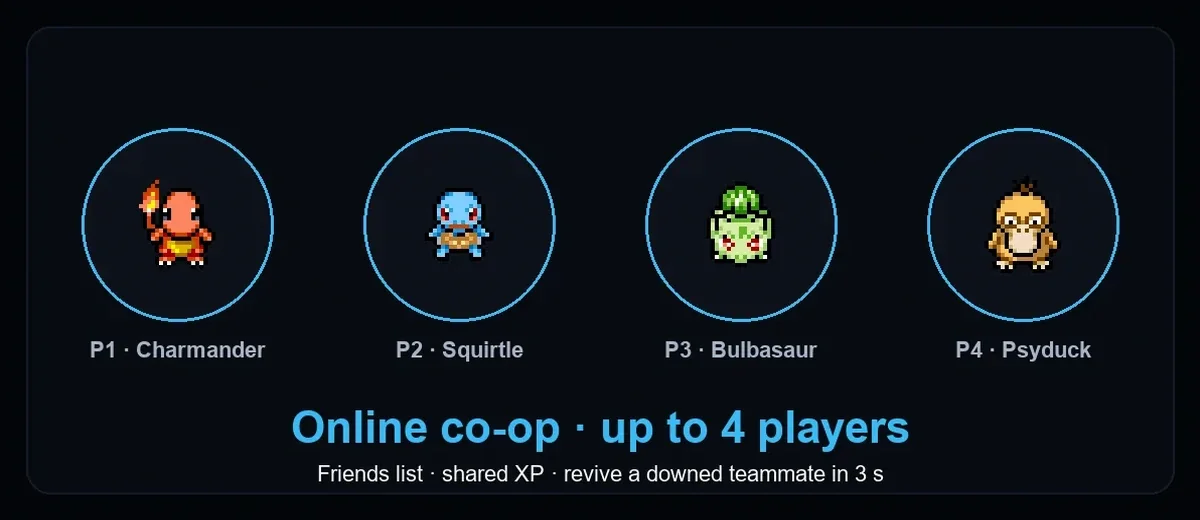
PokeSurvivor co-op basics
According to the official guide, PokeSurvivor co-op is online play for up to 4 players, built on your friends list. You play the same run as the solo game: you only move, your partner Pokémon attacks on its own, and you pick upgrade cards as you level. The difference is that your teammates share the map, the horde and the experience bar with you.
- Players: 2 to 4 per run.
- Where: online only, at pokesurvivor.com, in the browser.
- Account: required. Progress lives on your account and cloud save, so a guest has nothing to keep.
- Ending: the run ends when every player is down.
If you have never played a solo run, we suggest one or two first. Our beginner guide to controls, cards and runs covers the controls, upgrade cards and move evolution, and all of that carries straight into a PokeSurvivor co-op run.
Setting up a room with friends
PokeSurvivor multiplayer works through the in-game friends list. The official guide describes three steps, and that is the whole flow. We won't make up menu names or lobby codes the sources don't mention.
- 1
Sign in
Every player signs in to an account. A guest cannot join a saved group run.
- 2
Add friends by nickname
Swap nicknames with the people you want to play with and add each other to the friends list.
- 3
Invite them to your room
Whoever invites is the host. Once everyone is in the room, the host starts the run.
In PokeSurvivor co-op, the host matters more than it seems. As the host rules below show, the host's browser tab and connection decide whether the run keeps going. In our runs, the player with the most stable internet and the fewest distractions hosts. On a phone? Our Chinese 手機版攻略 covers co-op on mobile browsers, including why a phone host should not switch apps mid-run.
Shared XP and level-ups
In PokeSurvivor co-op, the whole team shares one XP bar. When the bar fills, everyone levels up together. Each player picks their own card from their own three options (a new move, a move upgrade or a stat boost), and the game waits until all players have chosen before play resumes.
So each level-up briefly pauses the whole group. Nobody can fall behind in level, and it doesn't matter who picks up the experience orbs. Fan opinion: let your fastest teammate, or whoever took Magnet (+30% pickup radius, community observation), sweep the orbs while the others hold a safe spot. Also pick your card promptly. Three friends are waiting on you.
Downs and revives
When a player's HP hits zero, they go down instead of ending the run. A teammate revives them by standing next to them for 3 seconds, and the revived player comes back with half HP. Once all players are down, the PokeSurvivor co-op run is over.
Three seconds is a long time with a horde closing in. Our habit is to clear a little space first, then step in to revive, and have a second player cover the reviver. A revive brings the player back at half HP, so the revived teammate should back off and heal, not charge straight back in.
Difficulty scaling for 2, 3 and 4 players
PokeSurvivor co-op scales the horde to the number of players, n. The official design document gives two formulas:
- Enemy count × (1 + 0.75 × (n − 1))
- Enemy HP × (1 + 0.3 × (n − 1))
We worked the numbers out. "Per player" divides the enemy count by the number of players, and the total HP pool is count × HP compared with solo. Here is a visual breakdown of how each player count scales.
- Enemy count
- ×1.75
- Enemy HP
- ×1.30
- Enemies per player
- ×0.88
- HP pool/player
- ×1.14
- Enemy count
- ×2.50
- Enemy HP
- ×1.60
- Enemies per player
- ×0.83
- HP pool/player
- ×1.33
- Enemy count
- ×3.25
- Enemy HP
- ×1.90
- Enemies per player
- ×0.81
- HP pool/player
- ×1.54
| Players | Enemy count | Enemy HP | Enemies per player | Total HP pool | HP pool per player |
|---|---|---|---|---|---|
| 1 (solo) | ×1.00 | ×1.00 | ×1.00 | ×1.00 | ×1.00 |
| 2 | ×1.75 | ×1.30 | ×0.88 | ×2.28 | ×1.14 |
| 3 | ×2.50 | ×1.60 | ×0.83 | ×4.00 | ×1.33 |
| 4 | ×3.25 | ×1.90 | ×0.81 | ×6.18 | ×1.54 |
So each player faces slightly fewer enemies than in solo, but every enemy is tankier. In a 4-player PokeSurvivor co-op run, there is about 54% more enemy HP to chew through per person. Our reading is that bigger groups need more damage per player, not just more players. Power cards and move evolutions matter even more with friends.
The host, pausing and privacy
Group runs follow different rules from solo. The official news page sets three of them, and they all revolve around the host:
- Pausing doesn't stop the run. In PokeSurvivor co-op, the enemies keep coming if you open the pause menu, so don't treat it as a safe break.
- The host switching tabs pauses everyone. If the host's browser tab loses focus, the run pauses for the whole team.
- The host leaving ends the run. If the host closes the game or drops out, the run ends for every player.
The connection explains why the host is so central. According to the official home page, PokeSurvivor multiplayer connects browser to browser using WebRTC (the same technology as a video call), with a Firebase relay as a fallback when a direct link can't be made. A direct connection also means your teammates may be able to see your IP address, so the official advice is to play only with people you know. We agree: add friends you trust, not strangers from a comment section.
Fan advice that follows from all this: the host should keep the game tab in front for the whole run and avoid shaky connections such as mobile data on the move. Everyone else should step away only when the group agrees.
Rifts in a group
Mysterious rifts open during a PokeSurvivor co-op run too. In a group, everyone enters the rift together and fights the legendary as a team in its type arena. A rift fight lasts 2 minutes. You lose when all of you are down or time runs out, and a loss sends you back to the map with 30% HP and no prize. A win can pay a ×10 gacha ticket (in the current code the legendary drops one half the time).
Because the whole team goes in at once, we call out "rift" before anyone walks in, so nobody is pulled in mid-dodge with low HP. Our legendary rift guide with all 18 arenas covers terrain, weather and how we fight each one.
Leaderboards and the offline version
There are two leaderboards, Solo and Group, and both rank by survival time. A PokeSurvivor co-op run goes on the Group board, so it doesn't compete with solo times.
The itch.io page also offers an offline HTML5 package ("Unzip and double-click index.html"). In its own words: "The offline version is solo only and saves in your browser." Co-op, cloud saves and leaderboards are only online at pokesurvivor.com. If you want to play PokeSurvivor with friends, use the website, not the download.
Team tips (fan opinion)
Here is how we like to build a PokeSurvivor co-op team. These are opinions, not official advice, but each one builds on a documented mechanic.
- Mix move patterns. Starting moves differ a lot. Bubble is an 8-bubble nova that slows, Vine Whip is a wide melee arc with knockback, and Water Gun pierces and is "reliable at any distance". A team that pairs a close-range clearer with a ranged damage dealer covers more angles than four of the same move.
- Cover different types. The softened type chart works both ways: super effective ×1.6, not very effective ×0.6, immunity ×0.3. Different types across the team mean someone almost always hits a legendary or boss for good damage. See the official type chart.
- Have one support-minded player. Stat cards such as Synthesis (+0.9 HP/s, community observation), Armor (+6% damage reduction, community observation) and Vigor (+20 max HP, community observation) keep the designated reviver alive through the 3-second revive.
- Focus the right enemies. The official guide says to kill healers and shielders first. With the extra enemy HP in a group, a Shielder adding 35% HP shields (community observation) to six allies hurts even more.
- Stack damage. Given the HP-pool table above, we lean toward Power cards and evolving moves early in 3 and 4 player runs.
For which partners to bring, see the strongest partners on our tier list, and pick types that complement each other rather than four copies of the top pick. Still choosing who to start with? Our guide to the best starter Pokémon compares the early options.
Co-op FAQ
How many players can join?
A PokeSurvivor co-op run holds up to 4 players: you plus 3 friends.
Can I play co-op as a guest?
No. Every player in a PokeSurvivor co-op run needs an account, because guests save nothing.
Does the itch.io download have multiplayer?
No. The offline version is solo only.
What happens if the host disconnects?
The run ends for everyone. The host section above also explains what tab switching and pausing do.
Is PokeSurvivor multiplayer free?
Yes. The game is a free, non-profit fan game with no ads or purchases, according to the official site.